


ToonScroll:Your Story Universe
NovaBeats
I approached ToonScroll: Your Story Universe as a relaxed entertainment app rather than something to finish or master. Its focus is a mix of toons, stories, and audiobooks, so the appeal comes from browsing until something matches my mood. That makes it an easy app to open during a quiet break, before bed, or when I want background listening without committing to a long film or a demanding game.
The first thing worth understanding is that this is not simply a conventional comic reader or a standard audiobook player. The experience sits between visual storytelling and spoken entertainment. Some moments invite you to scroll and look, while others are better suited to listening. That variety is its strongest reason to exist, although it also means the app may feel less focused than a service built around only one format.
ToonScroll is a free entertainment app from NovaBeats, with optional in-app purchases ranging from $0.99 to $149.99 per item. It is intended for mature users aged 17 and over. The app has reached over 500 thousand installs and holds a 4.1 average from around 10 thousand ratings, which suggests a sizeable audience but also leaves room for individual differences in taste and expectations.
What the first session feels like
After installing it, I would recommend resisting the temptation to judge the entire app from the first item that appears. A mixed library can be unpredictable: one story may suit you immediately, while the next may feel less polished or simply belong to a genre you do not enjoy. The best first session is exploratory. Scroll through the available choices, notice which formats keep your attention, and treat the opening minutes as a way to learn how the catalogue is arranged.
The store short description calls the experience “ToonScroll,” while the longer summary points to toons, stories, and audiobooks. In practical terms, that means a new user should expect variety rather than a single continuous narrative world. I found that distinction important because someone looking for one specific comic series may prefer a dedicated reading platform, whereas someone who enjoys sampling different kinds of storytelling may appreciate the broader mix here.
Related News

Why WhatsApp Messenger Still Makes Everyday Communication Feel Easy

Jurassic World: The Game Is the Better Dino Tycoon for Strategic Players

Threads in Real Life: Who Should Join, Lurk, or Leave

How SHEIN Turned Shopping Into an Endless Content Feed

How to Make Fortnite Feel Smarter on Mobile

Should You Switch to Microsoft Outlook on Mobile?
The app is especially suitable for short, interrupted sessions. I can imagine using it while waiting for an appointment, taking a lunch break, or winding down when I do not want to choose a full-length video. A visual story can provide something to browse, while an audiobook-style selection can work when my phone is not in front of me. That flexibility is more useful than it first sounds, because it lets the same app fit different parts of the day.
There is also a trade-off. A broad entertainment catalogue can make discovery enjoyable, but it can make the first meaningful choice less obvious. If you open the app expecting a tightly curated queue, the range may feel scattered. I would approach it with a simple goal: find one title or listening experience that holds my attention for several minutes, rather than trying to understand the whole library immediately.
Getting ready without overthinking the setup
The app supports devices running Android 5.0 or later, so compatibility should cover many older Android phones as well as newer models. Once it is installed, I would start by checking the main browsing areas and learning the difference between visual content and audio-led content. That small orientation step prevents a common mistake: opening something expecting a comic and then wondering why the interaction feels more like listening, or choosing an audiobook when you wanted something to read with your eyes.
Gallery
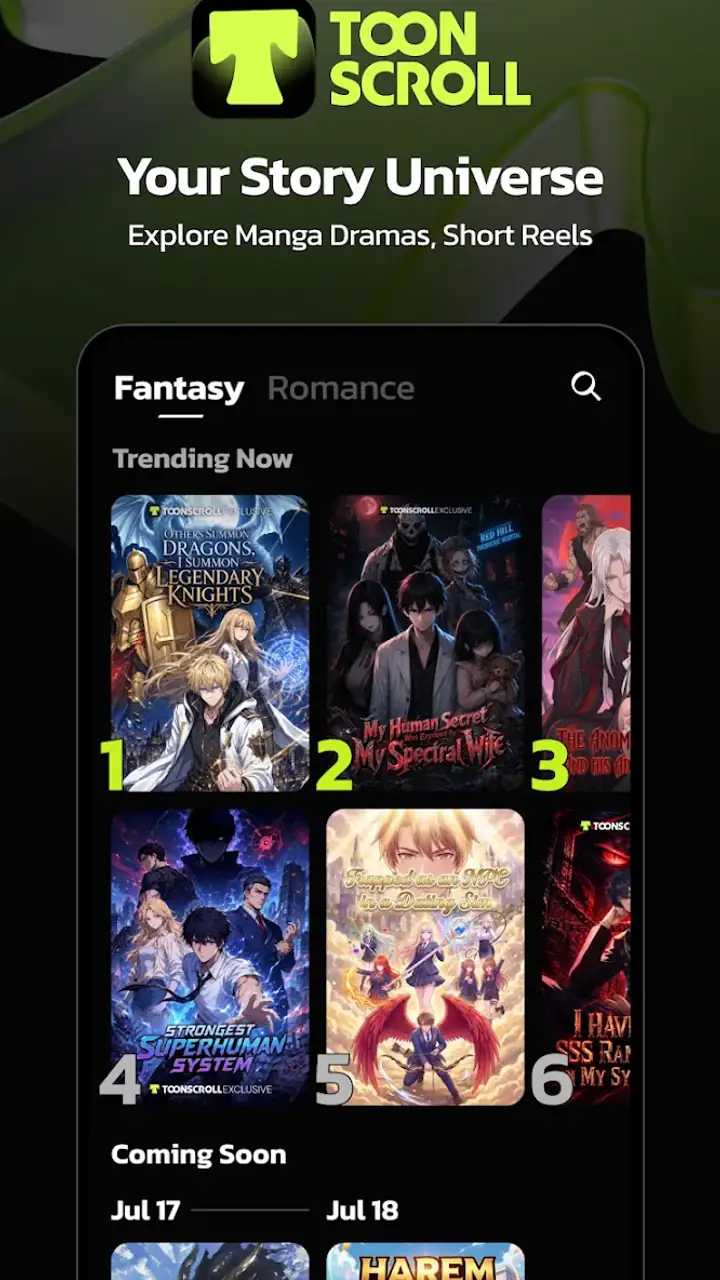
I would also make the first session deliberately low-pressure. Do not spend too long trying to build a perfect personal library before experiencing anything. Open a promising item, spend enough time with it to understand its presentation, then return to browsing if it is not a match. This is a better workflow for a catalogue built around discovery than repeatedly comparing thumbnails without actually starting a story.
Because the app is free to download but includes paid items, I would pay attention to the point at which a selection asks for a purchase. The useful habit is to explore the free experience first and decide whether the presentation works for you before spending money. The broad price range means a purchase can be a minor impulse buy or a much more substantial commitment, so I would not treat every item as if it carried the same cost.
That is also where the mature age rating matters. I would not install it on a child’s device simply because the interface may look colorful or cartoon-oriented. “Toons” does not automatically mean children’s content, and the 17+ classification is a clear signal to use personal judgement about who should access the app.
Finding the first thing worth returning to
My recommended first action is simple: choose one visual story and one audio-focused option, then compare how each fits your routine. The visual choice is useful when you have a few uninterrupted minutes and want to control the pace yourself. The audio choice is more practical while doing a quiet household task or resting your eyes. This two-format test tells you quickly whether the app’s variety is genuinely useful to you or merely makes browsing feel busy.
A good way to make that test meaningful is to avoid switching every few seconds. Give the first selection enough time to establish its tone and format. If it fails because the subject is not for you, try another item; if it fails because the presentation itself is uncomfortable, that is more valuable information. You are not only choosing a story, you are deciding whether the app’s way of delivering stories suits you.
I also suggest using a small personal rule: save or remember only the items you would realistically open again. This keeps discovery from turning into a cluttered collection of things that looked interesting for a moment. With mixed entertainment, the strongest titles are often not the most visually striking ones; they are the ones that fit a repeatable situation, such as a short evening break or a regular listening window.
For a first-time user, success should mean more than launching a title. It should mean finding a dependable use case. For example, I might decide that ToonScroll is my choice for ten minutes of visual reading after dinner, while another app remains better for long-form audiobooks. That kind of division makes the app easier to keep using and avoids expecting it to replace every entertainment service at once.
Where new users may hesitate
The biggest possible confusion is the relationship between the three content types. Toons, written stories, and audiobooks do not necessarily encourage the same behavior. A reader expects page control and visual pacing; a listener expects clear audio progression; a casual browser expects quick recommendations. When those experiences share one app, the controls and navigation may feel less immediately obvious than they would in a specialist product.
My advice is to identify the format before judging the controls. If you are reading, look for the natural scrolling rhythm instead of assuming it behaves like a printed book. If you are listening, give your attention to the playback area rather than repeatedly returning to the catalogue. This sounds basic, but it prevents the common first-session frustration of treating every item as though it uses the same interaction model.
Another point of friction is the difference between free access and optional purchases. A free download does not mean every appealing item is included without charge. I would explore calmly, read any purchase prompt before confirming, and avoid tapping through simply because the next story looks interesting. This is particularly important for households where another person might use the same device.
The mature rating can also create a misleading expectation in either direction. Some users may assume every title is extreme because of the age label, while others may ignore it because the artwork looks playful. Neither assumption is helpful. I would treat the rating as a reason to preview the tone and choose content carefully, especially if I were recommending the app to someone else.
Performance expectations deserve a practical note as well. The current version is 5.7.1, and the app has evolved since its release on March 16, 2022. Even so, a phone’s age, available storage, headphones, and connection quality can affect how comfortable an entertainment app feels. If a visual item seems awkward, I would first check whether the problem is the content format or the device environment before deciding that the whole service is unsuitable.
How it compares with more focused alternatives
Compared with a dedicated comic or webtoon reader, ToonScroll’s advantage is breadth. I can move from visual storytelling toward spoken content without changing the overall entertainment habit. The disadvantage is that a specialist reader will usually feel more purposeful to someone who wants advanced reading organization, a very deep focus on one format, or a carefully structured reading routine.
Against a traditional audiobook service, the app is more flexible but potentially less ideal for someone who listens for hours every day. A specialist audio platform is usually the better choice when your priority is a large, organized listening catalogue and a workflow built entirely around books. ToonScroll makes more sense when audiobooks are one part of your entertainment diet rather than the only reason you opened the app.
It also differs from video streaming. Video demands your eyes and usually asks for a longer uninterrupted block of attention. Here, visual stories can be more lightweight, while audio content can leave your screen free. That does not make it automatically better; it simply gives me another option when I want storytelling without starting a full episode or movie.
The most useful comparison, then, is not about which service has more content. It is about whether you value switching formats. If you want one polished, highly specialized experience, a focused alternative may be more satisfying. If you like browsing between illustrated stories and audio entertainment, NovaBeats’ approach has a practical advantage that a single-format app cannot provide.
Small habits that make the catalogue easier to use
My first tip is to match the format to your attention rather than choosing by title alone. Use visual content when you can look at the screen, and reserve audio-led selections for moments when your hands or eyes are occupied. This simple separation makes the app feel more intentional and helps reveal which part of its catalogue is actually valuable in your life.
My second tip is to judge a story by repeatability. An item that works during a short break may be more useful than one that requires a long, uninterrupted session. If you regularly have small pockets of free time, prioritize selections you can return to without needing to reconstruct the entire plot. That is a more realistic test than asking whether the app can replace a full evening of entertainment.
My third tip is to keep purchases separate from experimentation. Use free browsing to understand your taste, then spend only when a particular item has proved that it fits your routine. The range from $0.99 to $149.99 per item makes this especially important: the low end may feel casual, but the high end requires a deliberate decision. I would never let the novelty of a colorful catalogue make that decision for me.
A fourth useful habit is to review the app with headphones and without them. Audio-focused content may feel completely different depending on your listening environment, while visual stories may be easier to enjoy silently. Testing both situations gives you a better idea of whether ToonScroll can serve your everyday routine or only one narrow moment.
Who should try it, and who should skip it
I would recommend it to someone who enjoys discovering different kinds of storytelling and does not need every title to follow the same format. It is a good candidate for casual readers, occasional audiobook listeners, and people who like having a colorful entertainment option for short breaks. The free entry point also makes it reasonable to explore before deciding whether the catalogue deserves further attention.
I would be more cautious about recommending it to a child, because the content rating is Mature 17+. I would also point dedicated comic readers toward a specialized reading app if their main concern is a deep, organized reading workflow. Likewise, a heavy audiobook listener may prefer a service designed purely for long-form audio rather than a mixed catalogue.
People who dislike browsing may find the variety tiring. If you want to open an app and immediately resume one clearly organized series, a more focused alternative could save time. ToonScroll rewards curiosity, but curiosity can become friction when you are tired and only want a predictable next chapter.
My recommendation after using it
ToonScroll: Your Story Universe works best when I treat it as a flexible entertainment shelf, not as a replacement for every specialized app on my phone. Its combination of toons, stories, and audiobooks gives it a distinctive place, particularly for users whose attention changes throughout the day. The experience is more appealing when I choose content according to the moment instead of expecting one format to do everything.
The 4.1 average and broad install base suggest that many people find enough value to keep exploring, but those figures should not override your own first session. The real question is whether you can find one format and one routine that feel natural. If you can, the app becomes a convenient source of lightweight storytelling. If you cannot, its variety may feel like unnecessary navigation compared with a dedicated reader or audiobook service.
My final advice is to install it with a specific experiment in mind: try one visual story, try one audio selection, check how the free experience fits your habits, and only then consider an optional purchase. That approach is reassuring for first-time users because it avoids pressure and gives the app a fair test. Its best feature is the freedom to move between storytelling styles, but that freedom is worthwhile only when the choices genuinely fit your day.
FAQs for ToonScroll:Your Story Universe
What is ToonScroll: Your Story Universe?
ToonScroll: Your Story Universe is an interactive storytelling app built around illustrated, comic-style episodes and character-driven narratives. Instead of simply reading a static story, users can explore a visually presented universe, follow different characters, and experience stories in a format designed for short, engaging sessions. It is aimed at readers who enjoy comics, serialized fiction, and mobile entertainment with a more immersive presentation.
Is ToonScroll: Your Story Universe free to download and use?
The app can generally be downloaded without an upfront purchase, but some stories, episodes, features, or in-app content may require payment. Availability can vary depending on the title and region, so it is worth checking the store listing and the purchase details before starting. Users should also review whether the app includes advertisements, subscriptions, or optional purchases that unlock additional story content.
Does ToonScroll require an internet connection?
ToonScroll may need an internet connection to download stories, load artwork, synchronize progress, and access newly released episodes. Some content could remain available after it has been loaded, but offline access should not be assumed for the entire catalog. If you plan to read while traveling or without mobile data, open the desired episodes beforehand and check whether they continue working when the connection is unavailable.
Is ToonScroll: Your Story Universe suitable for children?
Suitability depends on the individual stories available in the app, because interactive fiction platforms can include different themes, levels of romance, suspense, conflict, or mature topics. Parents should review the age rating, privacy information, and in-app purchase settings before allowing younger users to access it. Enabling purchase restrictions and checking the content together is recommended for family use.
What devices support ToonScroll: Your Story Universe?
ToonScroll: Your Story Universe is intended for supported Android and iOS smartphones or tablets, although exact compatibility depends on the operating system version, device model, and regional store availability. Before downloading, confirm that your device meets the listed requirements and has enough free storage for the app and its story assets. Keeping the operating system and application updated can also improve stability and loading performance.
Pros
- Easy-to-use interface for browsing and discovering new stories.
- Personalized recommendations help match content to your interests.
- Short episodes make it convenient to read during quick breaks.
- Visual storytelling is engaging and accessible for casual readers.
- Regular content updates can keep the reading experience fresh.
Cons
- Some stories or features may require in-app purchases to access.
- The app may feel repetitive if you prefer longer
- traditional novels.
- Content availability can vary by region or account settings.
- Frequent notifications may become distracting without customization.
- A stable internet connection may be needed for the best experience.


